Building an online casino website is not like building a regular business site. You need more than just a pretty design. You need security, speed, reliability, and the ability to handle real-time transactions. You also need to comply with strict regulations. Choosing the right framework or Content Management System (CMS) is one of the most important decisions you will make.
This guide breaks down the best options for online casino platforms. We look at frameworks and CMS solutions that are secure, scalable, and built for high-traffic gaming sites. Whether you are starting from scratch or upgrading an existing platform, this article will help you make the right choice.
What Makes an Online Casino Different from a Regular Website
Before we compare frameworks, let us look at what an online casino needs that a normal website does not.
Security is number one – You handle real money, personal data, and payment details. A breach would destroy your reputation and your business. Your platform must have bank-grade encryption, secure login systems, and protection against hacking attempts.
Speed matters more than ever – Casino games, live dealer streams, and instant deposits all need fast response times. If your site lags, players leave. Search engines also rank faster sites higher.
Real-time functionality – Players expect instant updates on their balances, game results, and bonuses. Your system must handle thousands of concurrent users without slowing down.
Regulatory compliance – Online casinos must follow strict rules in every jurisdiction. Your platform needs features like age verification, self-exclusion tools, and responsible gambling controls.
Payment integration – You need to connect with multiple payment providers, process deposits and withdrawals, and keep transaction records secure.
Game integration – Most casinos use third-party game providers. Your platform must integrate smoothly with their APIs.
Now let us look at the best frameworks and CMS options for this demanding environment.
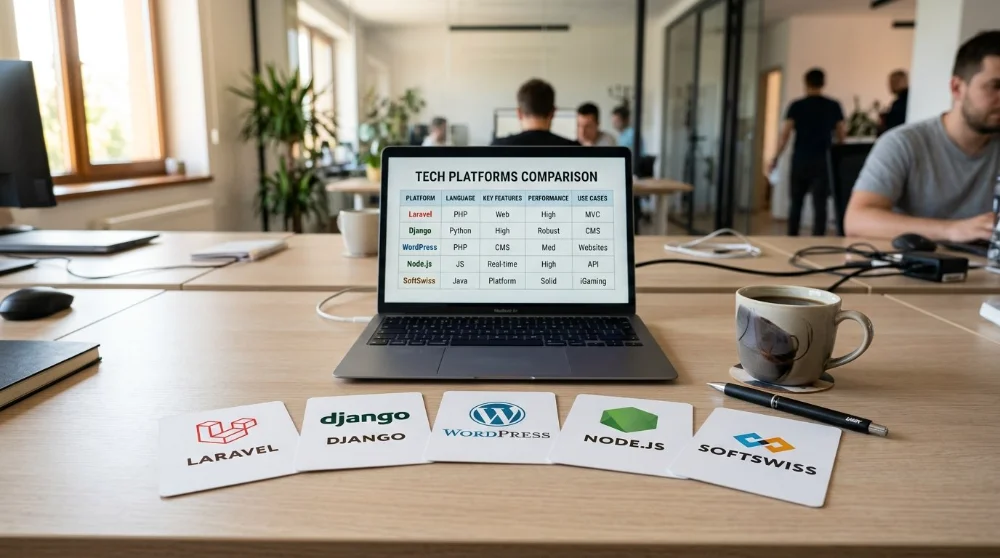
Option 1 – Custom Development with a Framework
If you have a significant budget and want total control, custom development is the best route. You build your platform from the ground up using a robust framework. This gives you complete flexibility, maximum security, and the ability to scale as you grow.
Laravel (PHP)
Laravel is one of the most popular PHP frameworks in the world. It is mature, well-documented, and has a huge community. Many online casinos and gaming platforms use Laravel.
Why Laravel works for casinos – It has built-in security features like encryption, hashing, and protection against SQL injection. Its authentication system is robust and easy to customise. The framework handles high traffic well when properly optimised.
Laravel also has excellent support for API integrations. This matters because you will connect to payment gateways, game providers, and third-party services. The queue system helps manage background tasks like sending emails or processing withdrawals.
Drawbacks – PHP can be slower than some compiled languages. However, with good server setup and caching, this is rarely a problem. You also need experienced Laravel developers, which can be more expensive than WordPress developers.
Best for – Operators who want full control, have a development budget, and plan to build a unique platform with custom features.
Django (Python)
Django is a high-level Python framework known for its “batteries-included” approach. It comes with many built-in features that speed up development.
Why Django works for casinos – Security is a core part of Django. It protects against common attacks like cross-site scripting, cross-site request forgery, and SQL injection. Its authentication system is comprehensive and can handle complex user roles.
Django is also very scalable. Many high-traffic sites use it successfully. The framework encourages clean, maintainable code, which is important as your platform grows. Python itself is a fast language to develop in, which reduces time to market.
Drawbacks – Django has a steeper learning curve than some other options. It is also more opinionated – it expects you to do things “the Django way”. This can be limiting if you want to stray from its conventions.
Best for – Teams that prefer Python, value security out of the box, and are building a data-heavy platform with complex logic.
Node.js with Express
Node.js is not a framework itself but a runtime environment. Combined with Express, it creates a powerful back-end for real-time applications.
Why Node.js works for casinos – Node.js is built for real-time applications. It handles many concurrent connections without blocking. This is perfect for live dealer games, chat features, and instant updates on player balances.
JavaScript is the language of the web. Using Node.js means your front-end and back-end can share code and logic. This speeds up development and makes maintenance easier.
Drawbacks – Node.js is less “batteries-included” than Django or Laravel. You need to choose and configure many components yourself. This requires more architectural planning.
Best for – Platforms that rely heavily on real-time features, such as live casinos or multiplayer games.
Ruby on Rails
Ruby on Rails was one of the first frameworks to prioritise developer happiness and rapid development. It is still a solid choice for many web applications.
Why Rails works for casinos – Rails is excellent for prototyping and building MVPs quickly. It has a strong focus on convention over configuration, which reduces decision fatigue. Security features are built-in, including protection against common web vulnerabilities.
Drawbacks – Ruby is slower than Python or Node.js in some benchmarks. Rails also has a reputation for being less fashionable than newer frameworks, though it remains productive and reliable.
Best for – Startups that want to launch quickly and iterate based on user feedback.

Option 2 – Using a CMS for a Casino Site
Some operators prefer to use a CMS because it lowers development costs and allows non-technical staff to manage content. However, not every CMS is suitable for a casino. You need one that prioritises security and performance.
WordPress with Customisation
WordPress powers over 40% of all websites. It is flexible, easy to use, and has a massive ecosystem of plugins and themes. For an online casino, WordPress is not the obvious choice, but it can work with the right setup.
Why WordPress can work for casinos – It is easy to set up and manage. Content editors can update promotions, blog posts, and pages without developer help. There are plugins for SEO, security, and payments.
Some casino operators use WordPress as their main site and integrate game lobbies via iframes or subdomains. The game platform runs on a separate, more secure system while WordPress handles the marketing and content side.
Drawbacks – WordPress was built for blogging, not for real-time gaming. Without extensive customisation, it is not secure enough for handling money. Plugins can introduce vulnerabilities. The performance is not optimised for high-traffic real-time applications.
Best for – Smaller operators or those using WordPress for the marketing site while hosting the game platform elsewhere.
Drupal
Drupal is a powerful CMS with stronger security features than WordPress. It is used by governments, universities, and large corporations.
Why Drupal can work for casinos – Drupal has a robust user permission system. You can control exactly who sees what. Its security track record is excellent. It also handles complex content structures well.
Drawbacks – Drupal has a steeper learning curve than WordPress. Development costs are higher. The community is smaller, so finding developers with Drupal and casino experience is harder.
Best for – Larger casino sites with complex content needs and a budget for development.
Joomla
Joomla sits between WordPress and Drupal in terms of complexity and features. It is less popular than either.
Why Joomla works for casinos – Joomla has good user management and access control features. It is more secure out of the box than WordPress.
Drawbacks – Joomla’s ecosystem is smaller than WordPress. Extensions are fewer and often less polished. Development is harder to outsource.
Best for – Teams that already use Joomla and want to extend it for a gaming site.
Option 3 – Enterprise CMS Platforms
If you run a large casino operation, you might consider enterprise-level solutions. These are built specifically for the gaming industry.
SoftSwiss
SoftSwiss is a well-known platform provider for online casinos. It offers a complete solution, including a back-end, game aggregator, payment processing, and front-end templates.
Why SoftSwiss works – It is purpose-built for casinos. Everything is included: security, compliance, game integration, and payment connections. You do not need to build from scratch.
Drawbacks – You are locked into their ecosystem. Costs are higher. Customisation is limited to what the platform allows.
Playtech
Playtech is another major player in the casino software space. It offers both B2B and B2C solutions.
Why Playtech works – It is a proven platform with decades of experience. It has integrations with hundreds of game providers.
Drawbacks – High costs. Long implementation times. Less flexibility than building your own.
EveryMatrix
EveryMatrix offers a modular casino platform. You can pick the components you need – game aggregator, player management, payment processing, and more.
Why EveryMatrix works – Flexibility to choose what you need. Strong API focus. Good for operators who want to integrate multiple providers.
Drawbacks – Requires technical expertise to set up and manage. Costs scale with usage.
Option 4 – Headless CMS with Custom Front-End
A headless CMS separates the content management back-end from the front-end presentation. You manage content in one place and deliver it via APIs to any front-end – web, mobile app, or other devices.
For online casinos, this approach is growing in popularity.
Strapi
Strapi is a popular open-source headless CMS. It is built with Node.js and is highly customisable.
Why Strapi works for casinos – You get a clean back-end for managing content like promotions, game descriptions, and bonus rules. The front-end is built separately, allowing you to optimise performance and security independently.
Drawbacks – You need a separate front-end development team. You still need to build the gaming functionality yourself.
Contentful
Contentful is a commercial headless CMS. It has a polished interface and excellent developer tools.
Why Contentful works – Contentful handles content delivery at global scale. Its API is fast and reliable.
Drawbacks – Costs are higher than open-source options. Data is hosted on their cloud, which may raise privacy concerns.
Option 5 – Cloud-Based Solutions and PaaS
Some operators use Platform as a Service (PaaS) solutions that combine development frameworks with hosting and scaling.
AWS Amplify
AWS Amplify is a development platform from Amazon. It provides tools for building, hosting, and scaling applications.
Why Amplify works for casinos – It integrates with AWS’s vast ecosystem, including security, databases, and analytics. Scaling is automatic.
Drawbacks – Vendor lock-in. Costs can rise quickly with usage.
Google Firebase
Firebase is a mobile and web development platform from Google. It provides real-time databases, authentication, and hosting.
Why Firebase works – Its real-time database is perfect for live features. The authentication system is robust.
Drawbacks – Realtime database has limitations on querying. Costs increase with data size.
Comparison Table
| Platform / Framework | Security | Speed | Real-time | Flexibility | Cost | Ease of Use |
|---|---|---|---|---|---|---|
| Laravel | Very high | High | Moderate | Very high | Medium | Medium |
| Django | Very high | High | Moderate | High | Medium | Medium |
| Node.js + Express | High | Very high | Very high | Very high | Low | Medium |
| Ruby on Rails | High | Medium | Moderate | High | Medium | High |
| WordPress | Low (without hardening) | Medium | Low | Medium | Low | Very high |
| Drupal | High | Medium | Low | High | High | Low |
| SoftSwiss | Very high | Very high | High | Low | Very high | High |
| Headless CMS | High | Very high | High | Very high | Medium | Medium |
Recommended Approach for Investinu.ie
Based on our analysis, here is what we recommend.
For a new casino platform with a development budget – Choose Laravel or Django. Both give you security, flexibility, and a strong community. Laravel is easier to find developers for in Ireland and the UK. Django is better if you prefer Python and want stronger out-of-the-box security.
For a platform with heavy real-time needs – Choose Node.js with Express. This is the best option for live casino features, multiplayer games, and instant player updates.
For a small operator on a tight budget – Consider WordPress for the marketing site and a third-party game platform integrated via iframes. However, we recommend upgrading to a custom solution as soon as your revenue allows.
For a large enterprise – Look at SoftSwiss, Playtech, or EveryMatrix. These platforms handle compliance, game integration, and payment processing for you. The trade-off is higher costs and less flexibility.
Security Is Non-Negotiable
Whichever framework you choose, security must be your top priority. Here are essential measures every casino site must implement.
- Use HTTPS with strong encryption (TLS 1.3).
- Implement two-factor authentication for all admin accounts.
- Use prepared statements to prevent SQL injection.
- Hash all passwords with bcrypt or Argon2.
- Store payment data separately from player data.
- Log all transactions and access attempts.
- Conduct regular security audits and penetration testing.
- Keep all software and dependencies up to date.
Performance and Scalability
An online casino must stay fast even when traffic spikes. Here is what to focus on.
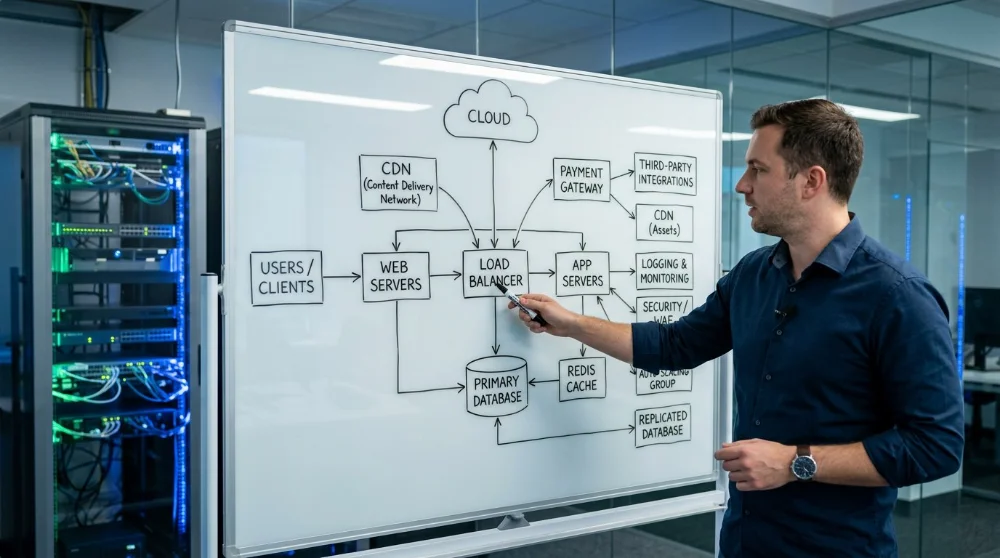
- Use a Content Delivery Network (CDN) for static assets.
- Implement database caching (Redis or Memcached).
- Use asynchronous processing for non-critical tasks (email, logs).
- Optimise images and scripts.
- Use load balancing to distribute traffic across multiple servers.
- Monitor performance continuously with tools like New Relic.
Regulatory Compliance
Your platform must help you comply with gambling regulations. Look for features like these.
- Age verification at registration.
- Geolocation to block restricted regions.
- Self-exclusion and cooling-off periods.
- Deposit limits and responsible gambling tools.
- Comprehensive audit trails for all financial transactions.
- Data protection compliant with GDPR.
The Role of the Front-End
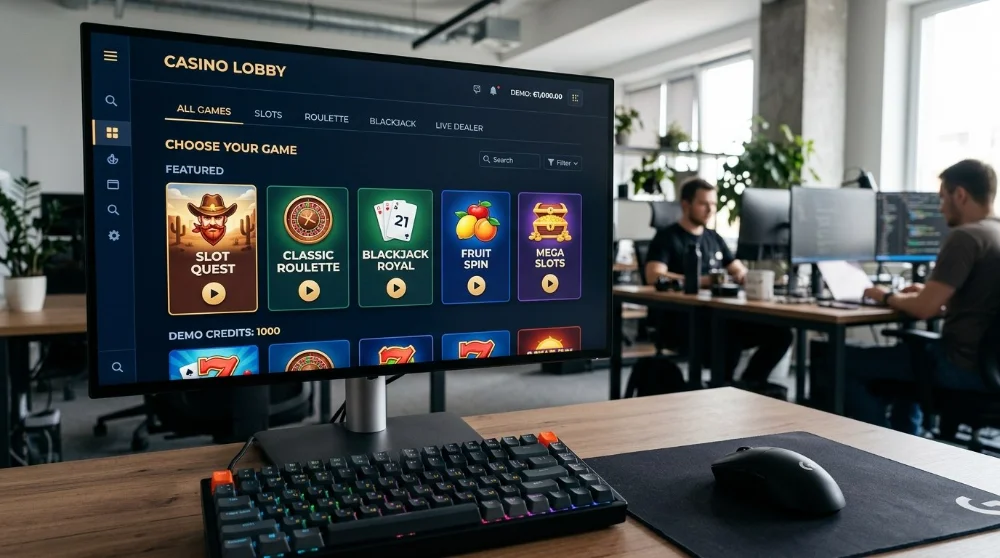
The front-end of your casino site is what players see and interact with. It must be fast, responsive, and engaging.
Consider using modern JavaScript frameworks like React, Vue.js, or Svelte. They offer smooth user experiences and are easy to connect to any back-end API.
React – Most popular choice. Huge ecosystem and community support.
Vue.js – Easier learning curve than React. Good for smaller teams.
Svelte – Newer but gaining popularity. Very fast because it compiles to vanilla JavaScript.
Integration with Game Providers
Your platform must connect to game providers like NetEnt, Microgaming, Play’n GO, and Evolution Gaming. Most provide REST APIs or SDKs.
Choose a framework that makes API integration simple. Laravel’s HTTP client, Django’s requests library, and Node.js’s fetch or axios all work well.
Hosting Considerations
Your choice of hosting affects security, speed, and uptime. For an online casino, we recommend dedicated servers or cloud hosting with high availability.
AWS – Market leader with global reach.
Google Cloud – Strong in data analytics and AI.
Azure – Good for Windows-based workloads.
Dedicated hosting in Ireland – Low latency for local players. Check providers like Blacknight or Hosting Ireland.
Budget Planning
Here is a rough guide to costs.
- Custom development (Laravel/Django/Node) – €30,000 to €150,000+ depending on features.
- WordPress solution – €5,000 to €20,000 for setup plus monthly fees.
- Enterprise platform (SoftSwiss etc.) – €50,000+ setup plus revenue share.
- Hosting – €200 to €2,000+ per month.
- Security audits – €5,000 to €20,000 annually.
- Maintenance – 15-20% of development cost per year.
Final Recommendation
For Investinu.ie, we recommend the following path.
- Start with Laravel for the back-end. It is secure, well-supported, and has excellent documentation.
- Use React for the front-end. It gives a smooth user experience and works well with Laravel.
- Host on AWS or Google Cloud for scalability and reliability.
- Integrate with SoftSwiss or a similar game aggregator to access a wide range of games without building game logic yourself.
- Implement all security measures from day one.
If your budget is limited, begin with a WordPress marketing site and a basic game lobby. Then reinvest profits into custom development as you grow.
Conclusion
Choosing the right framework or CMS for an online casino is not a decision to rush. Security, speed, real-time capability, and regulatory compliance must all be considered. For most operators, custom development with Laravel, Django, or Node.js offers the best balance of control and security.
Enterprise solutions like SoftSwiss are excellent for large operations but come with higher costs and less flexibility. WordPress and other traditional CMS platforms are best used for marketing sites, not for the gaming platform itself.
Take your time, evaluate your needs, and choose a partner with experience in the gaming industry. A solid technical foundation will save you money, headaches, and reputational damage in the long run. Good luck with your casino project.