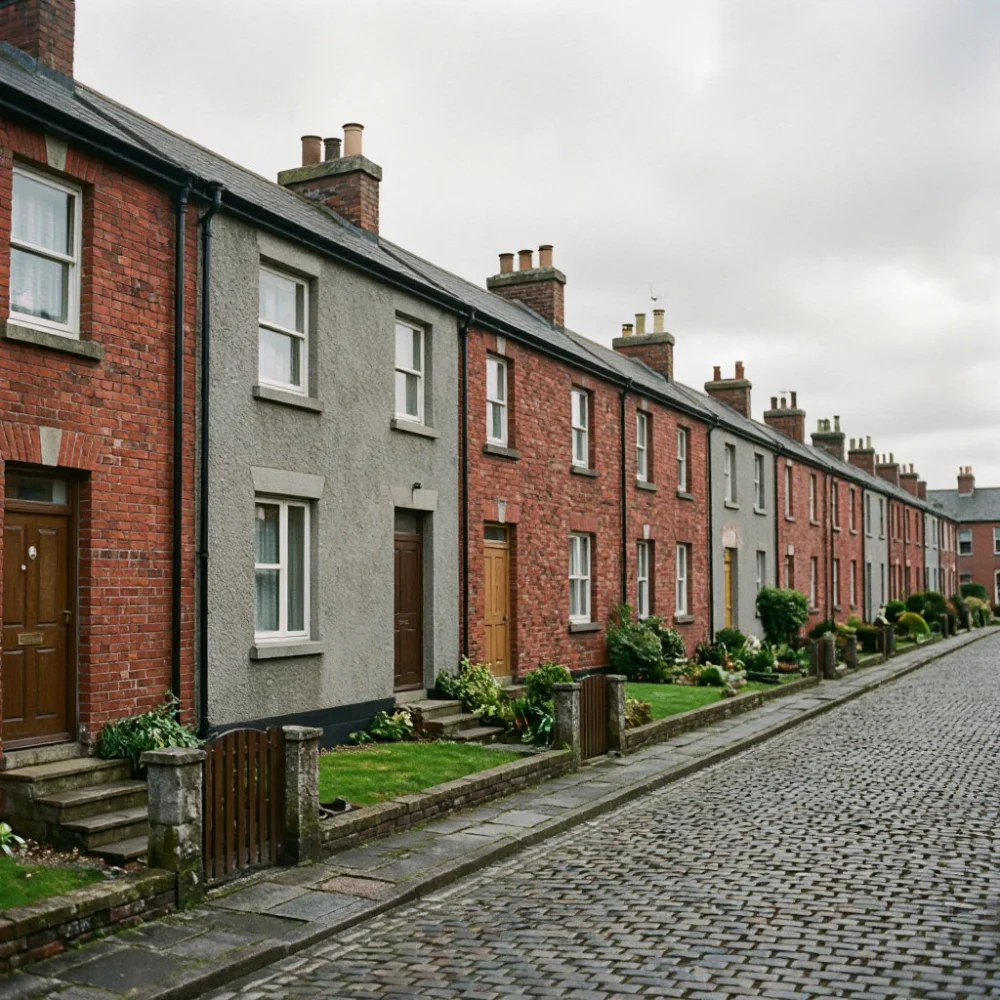
Irish households are facing a financial squeeze that has become a defining feature of daily life in 2026. Residential property prices rose by 5.6% in the year to June, the median price paid for a home reached €396,000, and rents continue to climb across every region of the country . At the same time, inflation has accelerated to 3.7%, the highest rate in four months, driven largely by an 11.8% surge in energy prices .
For ordinary savers and investors, the combination of rising costs and stagnant deposit returns creates a difficult equation. Money sitting in a standard Irish bank account is losing purchasing power every month. Understanding why this happens, and what can be done about it, is the first step toward protecting personal finances in an uncertain environment.
The Housing Market: Growth Slows, But Pressure Remains
Ireland’s property market has shown signs of moderation in 2026, but the underlying shortage of housing continues to drive competition and prices upward. In June 2026, 4,058 dwelling purchases were filed with the Revenue Commissioners at a total value of €1.82 billion . The annual increase of 5.6% represents the slowest rate since January 2024, down from 6.1% in May .
This is not a reversal. It is a slowdown in the pace of growth. Prices outside Dublin rose by 6.4%, while Dublin saw a 4.6% increase . The Border region, including Cavan, Donegal, Leitrim, Monaghan, and Sligo, recorded the highest growth at 10.5%, while Cork and Kerry saw the smallest increase outside Dublin at 3.7% .
The median price paid for a home nationally was €396,000. The most expensive Eircode area was Blackrock in south Dublin (A94), with a median price of €851,750. The least expensive was Castlerea in Roscommon (F45), at €157,000 .
For first-time buyers, the picture is particularly challenging. There were 1,705 first-time buyer purchases filed in June 2026, but affordability remains stretched. New research from PTSB found that over 52% of people under 35 believe they will never be in a position to buy a home .
The Rental Crisis: Rents Above Pre-Pandemic Levels
The rental market offers little relief. Dublin rents are now approximately 25% above pre-pandemic levels, and the national average rent for a two-bedroom apartment is €2,204 per month . In Dublin, the same property costs €2,634 .
The crisis is not confined to the capital. Rents in Connacht-Ulster and Munster have increased by 90% and 75% respectively over the past six years . In the second quarter of 2026, market rents were 13% higher year-on-year in Galway city, 12% higher in Cork, and 11% higher in Limerick .
Nationally, market rents rose by 1.4% between March and June, a significant slowdown from the record 4.4% increase in the first quarter . However, rents remain 42% above pre-Covid levels and 78% higher than ten years ago .
There were just under 2,400 homes available to rent nationwide on August 1, 2026. This masks a sharp divide: availability in Dublin fell by 18% over the year, while across the rest of the country it rose by 40%. Availability remains well below pre-pandemic norms, when there were typically over 4,300 homes available at any one time .
Inflation: Energy Costs Drive the Increase
Ireland’s annual inflation rate rose to 3.7% in August 2026, up from 3.4% in each of the previous two months . This is the highest rate in four months. On a monthly basis, consumer prices grew by 0.7% in August, following a 0.1% increase in the previous period .
The main upward pressure came from energy prices, which surged by 11.8% year-on-year, after a 6.5% advance in the previous month . Services inflation remained steady at 3.7%, while food price growth slowed significantly to 0.1% from 0.8% .
Excluding energy and unprocessed food, harmonised inflation moderated to 2.6%, down from 2.9% in the previous month . This suggests that underlying price pressures, while still present, are not accelerating as rapidly as headline figures might imply.
The EU-standard harmonised inflation rate (HICP) in Ireland quickened to 3.4% year-on-year in August 2026 from a five-month low of 3.1% in July .

Wages: Growth Outpaces Inflation, But Not Everywhere
Average weekly earnings in Ireland rose by 3.9% year-on-year to €1,046.88 in the second quarter of 2026, up from €1,007.58 in the same period of 2025 . Average hourly earnings increased by 3.8% to €31.96, while average weekly paid hours edged up by 0.3% to 32.8 .
Over the same period, consumer prices increased by 3.6% . This means that, on average, wage growth is marginally outpacing inflation. However, the picture varies significantly across sectors.
The Information and Communication sector remains the highest-paying area of the economy, with average hourly total labour costs of €61.40, followed by Financial, Insurance and Real Estate Activities at €53.79 and Education at €49.51 . At the other end of the scale, Accommodation and Food Service Activities recorded the lowest hourly labour costs at €20.27 .
Average weekly earnings grew most quickly in the Accommodation and Food Service sector at 7.7%, jumping from €470.59 to €506.78. The second-largest increase was 5.6% in Administrative and Support Service activities .
The national job vacancy rate stood at 1.3% at the end of the second quarter of 2026, unchanged from a year earlier but 0.1 percentage point higher than at the end of the first quarter .
The Savings Problem: Money Losing Value in Real Terms
Irish households have more than €170 billion on deposit with banks, with the vast majority of it earning virtually nothing in current or on-demand deposit accounts .
The numbers are stark. AIB offers 0.25% on lump-sum savings, Bank of Ireland offers 0.1%, and PTSB offers 0.01% . With inflation running at close to 4%, money in these accounts is losing value at a rate of more than 3% per year .
The Central Bank of Ireland’s data for June 2026 shows that the weighted average interest rate on household overnight deposits stood at 0.14% . For new household deposits with agreed maturity, the rate was 1.86%, a 5 basis point increase from May .
This is below the euro area average. The weighted average interest rate on new household term deposits in the euro area was 2.09% in June 2026, 23 basis points higher than the Irish rate. Ireland had the 13th highest interest rates on household deposits with agreed maturity in the euro area .
The Central Bank’s data also shows that the level of new business in household term deposits was €1.6 billion, the highest increase since October 2025, representing a growth of 43% since June 2025 .

Why Deposits Are Not Enough
The gap between deposit rates and inflation means that holding cash in a standard Irish bank account is a guaranteed loss in real terms. A saver with €100,000 in a standard instant-access account earning 0.25% AER would earn €250 in gross interest over a year. After DIRT at 33%, they would keep approximately €167 .
The same €100,000 in a one-year fixed-term deposit at 2.47% AER would earn €2,470 gross. After DIRT, the saver would keep €1,655. This is nearly ten times more for the same money over the same period .
Even at a demand deposit rate of 2.07%, the return after DIRT would be approximately €1,387, which is eight times the return of staying in a standard Irish bank account .
Nick Charalambous, managing director of Alpha Wealth, noted that Irish banks “have historically been slow to pass on ECB rate increases to savers, and the gap between what your main bank is offering and what is available elsewhere has never been more visible” .
Daragh Cassidy of Bonkers.ie added that rates of 3% or slightly more are currently available, but warned that “some of the headline rates you might see advertised only apply for one year or on balances up to a certain limit” .
Risk Management: A Broader Perspective
The challenge of protecting savings in a high-inflation environment raises a broader question about how individuals approach risk. Whether managing a personal budget, planning for retirement, or considering any form of financial commitment, the principles are similar: understand the risks, control what can be controlled, and avoid decisions driven by short-term emotion.
This applies across all areas of personal finance, including discretionary spending and entertainment. In industries where risk is inherent, such as sports betting, the concept of responsible play is well established. Budgeting, setting limits, and treating any expenditure as part of a broader financial plan are standard practices for anyone who wants to participate without exposing themselves to harm.
The same discipline applies to investing. Diversification, time horizon, and an understanding of one’s own tolerance for volatility are more important than chasing short-term gains. A saver who moves money from a low-interest deposit account into a diversified investment portfolio is taking on more risk, but also accepting a different set of trade-offs. The key is that the decision is made deliberately, with full awareness of what is at stake.
Practical Steps for Irish Savers in 2026
For those looking to protect their finances in the current environment, several options exist.
First, review where savings are held. Money in a standard current account or on-demand deposit is losing value. Fixed-term deposits offer higher rates, though the funds are locked for a set period.
Second, consider platforms that offer better returns. Raisin, for example, offers demand deposit accounts at up to 2.07% AER with immediate access, and fixed-term options ranging from 2.47% AER over one year to 2.85% AER over five years . All deposits are protected by the German guarantee, which covers sums up to €100,000 .
Third, think in terms of time horizons. Short-term savings of up to three years are best kept in deposit accounts with guaranteed protection. Medium-term money, from four to 10 years, may benefit from a blend of deposits and investments. Long-term savings of 10 years or more, a structured investment strategy appropriate to one’s risk profile will almost always outperform cash over time .
Fourth, be aware of tax obligations. DIRT is charged at 33% on all interest payments from Irish banks . Some foreign platforms do not deduct DIRT at source, meaning savers must file a tax return themselves .

Looking Ahead
The Irish economy in 2026 presents a mixed picture. Wage growth is outpacing inflation on average, and the pace of house price growth has moderated. However, the housing shortage remains severe, rents continue to rise, and energy costs are driving headline inflation upward.
For savers, the message is clear: money left in a low-interest account is money losing value. The gap between deposit rates and inflation is not closing quickly enough to protect purchasing power. Taking deliberate, informed action to move savings into higher-yielding accounts or diversified investments is no longer optional for those who want to preserve their financial position.
The principles that apply to investing also apply to other areas of personal finance. Understanding risk, setting limits, and making decisions based on long-term goals rather than short-term impulses are the foundations of financial stability. Whether managing savings, planning for a home, or simply trying to keep pace with the cost of living, the same discipline applies.