
It’s weird how in the Irish investment world, the simplest product often has the most complicated tax manual.
Exchange Traded Funds, or ETFs, are brilliant. You can buy a part of the global economy for the price of a beer. You can invest in a range of different funds without paying high fees. You won’t have to spend your evenings reading balance sheets either. If you’re in Ireland and you’re looking to build wealth outside of a pension or a property, these are the obvious first steps to take.
But then you try to buy one and you get confused. You’ll see that the fund you’re looking at says “UCITS” right on the tin. You’ll see options for “Accumulating” and “Distributing” that look the same, but are completely different. Then, as it happens, you hear people using the term “Exit Tax” to mean a penalty.
Let’s be real. Irish tax rules and ETFs are a bit of a tricky combo to get your head around. It’s not the easiest thing to use. But it’s not too tricky if you know the rules of the road. You don’t need to have a degree in finance to do this. All you need to know is what you’re buying.
The Domicile Dilemma: Why the address on the fund matters
First things first. If you’re an Irish investor, you might want to think about ETFs based in Ireland or Luxembourg. These are known as UCITS funds (that’s Undertakings for Collective Investment in Transferable Securities for those who don’t know). They’re regulated, safe and easy to get hold of on platforms like DeGiro or Davy.
There’s a very specific reason why Irish-domiciled ETFs are the ones you want in your portfolio, and it’s got nothing to do with the scenery.
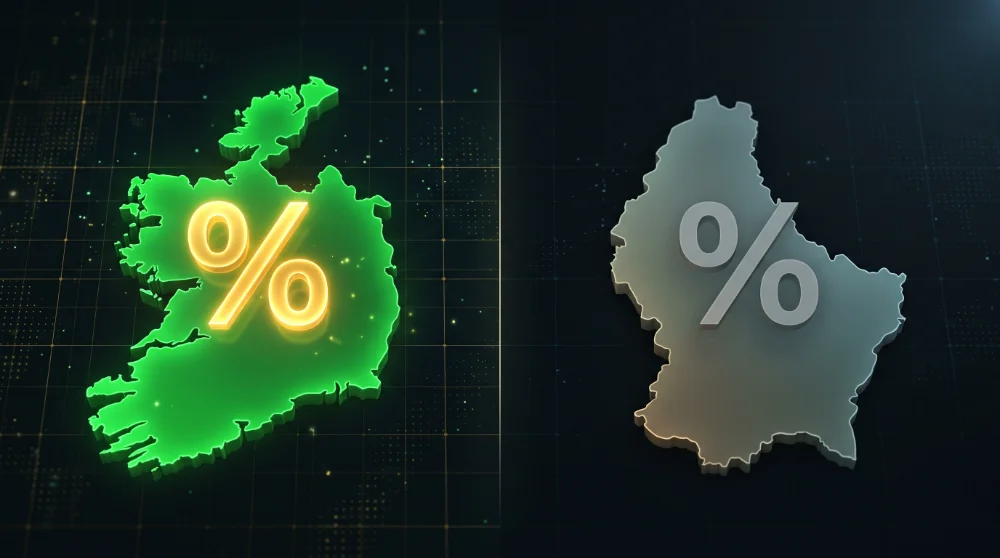
Basically, it’s all down to a written agreement between Ireland and the US. Because of an agreement between the two countries, an Irish fund only pays 15% tax on US profits. A fund based in Luxembourg pays 30%.
You might think a 15% difference is small. But over time, this difference grows. It’s the difference between a good retirement and a great one. That’s why big asset managers like Amundi moved billions from Luxembourg to Ireland, because it’s better for taxes. If you buy an Irish-domiciled ETF that tracks the S&P 500, you’ll get a higher dividend yield than if you buy the Luxembourg version.
There’s another, more serious reason to avoid US-domiciled ETFs. If you buy an ETF listed on the New York Stock Exchange, you’ll be affected by US Federal Estate Tax. If you’re not a US citizen, the exemption is just $60,000. Anything above that will be taxed at rates of up to 40% if you die. Irish-domiciled UCITS ETFs are a great way to protect yourself from this. Remember this.
Accumulating vs. Distributing: The tax trap

You will see two versions of almost every ETF. One says “Acc” and one says “Dis.”
A Distributing ETF takes the money it earns from the companies it owns and gives it to you as cash. An accumulating ETF basically takes the dividends it gets and puts them straight back into the fund.
For an Irish investor, the most common choice is Accumulating. Here is why.
If you hold a Distributing ETF, you get a small amount of money. But you have to pay tax on that payment. You have to declare it, and you may have to pay tax on it at your marginal rate (which can be over 50% when you include USC and PRSI). It creates a lot of paperwork every year, but the money it brings in is very small.
With an Accumulating ETF, the fund works for you. It buys more shares with the money it makes. You don’t receive cash, so you don’t have to report anything to the tax authorities. You only have to pay tax when you sell the fund, or when the eight-year rule applies. It’s a better way to manage your money.
The TER: Why 0.07% beats 0.20% every time
The Total Expense Ratio (TER) is the yearly fee that the fund manager takes out of your investment. It is taken out of your account automatically, so you don’t have to write a cheque for it, but it is the most important thing.
You will see that TERs for ETFs range from 0.03% for a simple US index to 0.50% or more for specialised or “thematic” funds.
Let’s say you invest €10,000. A TER of 0.07% costs €7 a year. A TER of 0.20% costs €20. That sounds silly.
But let’s think about the bigger picture. If you pay 0.13% more in fees than you need to, over 30 years you could end up paying thousands of euros more. The fund manager takes their share every year, no matter what the market is doing. Experienced investors know that when it comes to investing, the only thing you can control is the cost. You can’t control the market, but you can decide how much you pay to access it.
If you’re buying a basic index ETF, you shouldn’t pay more than 0.20% in fees. If you want to go higher, you need a really good reason.

Exit Tax: The 38% reality (and the 2026 change)
This is the part that makes people nervous. If you sell an Irish-domiciled ETF at a profit, you won’t have to pay Capital Gains Tax (CGT). You have to pay Exit Tax.
At the moment, 38% is the rate. This is more than the usual CGT rate of 33% that applies to individual shares. The logic is that ETFs are treated like other collective investment funds, which are subject to a specific tax regime.
But the rules are changing. The government has announced that, as part of the Finance (No. 2) Bill 2026, this rate will drop from 38% to 35% on 1 January 2027. It is a welcome cut, but it is still higher than CGT.
The most difficult aspect for investors in ETFs is the “Eight-Year Deemed Disposal” rule. Even if you never sell your ETF, the taxman treats you as if you sold it on the eighth anniversary of your purchase. You must pay tax on any profit you make, even if you haven’t received any money.

It is a lot of admin, but it’s not a reason to avoid ETFs. All you need to do is keep a record of when you bought them. If you use a platform like Davy or a similar broker, they will usually do the calculation for you. But you will still need to complete a self-assessment return.
If you want to see exactly how these numbers play out in real life, watch this breakdown. It walks through the math of the new 35% Exit Tax rate and explains exactly how the dreaded eight-year deemed disposal rule impacts a normal monthly investment plan. It is a great visual guide to see exactly what you will owe and when.
The bottom line
ETFs are not complicated because the basic idea is simple. They are complicated because the Irish tax system has its own peculiarities.
But you can still use it. Invest in Irish-domiciled UCITS ETFs to get the 15% US dividend rate. Choose the Accumulating version to avoid annual tax problems on dividends. Keep a close eye on the TER, because even tiny differences can add up to a big difference over 30 years. You will have to pay 35% on your gains (from 2027), instead of the usual 33%.
The system isn’t perfect. But it’s much better than leaving your money in a savings account that only earns 0.5% interest when inflation is so high.